


Peck-age Delivery is a pre-production package made as an academic deliverable for an ETC semester project.
The game itself centers a flightless bird trying to deliver packages in diverse animal world.
OVERVIEW
-
Preproduction Package for 3D-platformer
-
100+ page Game Design Document
-
Mechanics Prototype constructed in Unity
-
Full Level Design Concept + Animatic Walkthrough
PROCESS


For the spring semester, we were tasking with making a full preproduction package for a game of our choosing. Ideally the package should be robust enough to hand to a hypothetical production team to properly prototype, iterate, and push to production. After deliberating, we decided to design a cozy aesthetic 3D platformer which felt right for a peak COVID climate.
Half the team was tasked with character design and marketing. I was tasked with making the game's design and documenting it in a GDD. This included, character mockups, UI flow, macro and micro game loops, level and puzzle design concepts, and describing the mechanics.
The end package included character concepts, a market evaluation, and a 120 page GDD which included everything from lore to a full walkthrough of a level concept. We presented it as a presentation to the staff at the end of the semester and fielded questions.
We also provided a vertical slice of the game in the form of an animatic.
PLAYING "PECK-AGE DELIVERY"
Peck-age Delivery is inspired by 3D "collect-a-thon" platformers, like Super Mario 64 and Banjo Kazooie. We felt the fun whimsical nature of delivering a package could be similar to how you have collect items in a platformer, but in reverse by delivering items instead.


The world will be split in to biomes, and each biome will have several batches of letters to deliver to different parts of the level, like individual stars in a Super Mario 64 level.
Each biome will have its own addressing system that serves as its own puzzle for the player to sus out addresses as they drop off letters. The player will have a randomized set of letters that will naturally lead them to the end of the mission.


At the end of each mission, the player will deliver a sizable package to the goal at the end of the level. This will be its own individual object that the player will have to carry over their head. In that way, the package will serve as a challenge in itself to have to carry to the goal.
Several platforming challenges will involve using the package as a platform, however leaving the package to neglect will leave it venerable to enemies to damage it.


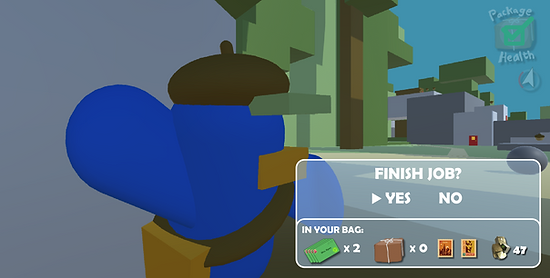
After delivering the final package, the player will exit the level to receive their grade on letter delivering accuracy.
LEVEL DESIGN RESEARCH

For research, I looked into Super Mario Odyssey's level design, since I wanted to play collect-a-thon fresh without prior bias. I learned a lot playing a game for research and took a lot of notes, but it boiled down to every level having a mish-mash of 3 key ingredients:
1. Linear Paths - Places where the exploration is exchanged for more focused challenge-based content.


2. Sandboxes - Open areas, where there is no clear order to explore, encouraging players to slow down and look around.


3. Landmarks - Clear identifiable structures that either serve for story/lore purposes and/or navigation.
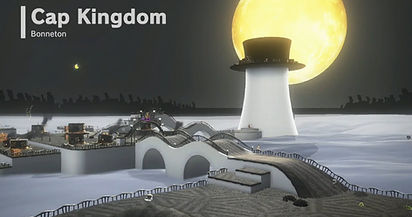
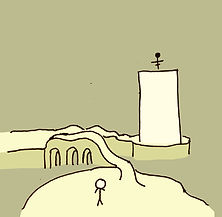
With that in mind, you can start to see that these elements play off each other to make up unique feeling levels without much more complexity at the sub-level.


These two levels start with different elements at it's macro level, but are made up same 3 ingredients at the micro level. On the left, the level is based off a large linear path connected with sandboxes and landmarks. On the right the level is one huge sandbox with plenty of nooks teeming with linear challenges.

Using what I learned I concluded levels should be a combo of sandbox with linear spokes coming off it. Games like these focused on sub-variants of a singular large area. For example, stars in Mario 64 aren't a completely new level, but a rearrangement of same level.


We decided to use this approach in our game, making a small shared "hub area" in our level that branches into unique avenues, testing different platforming and puzzle challenges. The branches would serve as different missions.
LEVEL BLOCKOUT OVERVIEW

With that in mind, I concepted out a level in Unity, specifically one of those "branches" on a hypothetically full level map.
For this block out, the biome is the Dense Forest, a wooded area where animals live in different treehouses at different altitudes. The main hub area of the biome would look like this, where a lot of interconnecting tree branches would serve as both a nice visual of environment scale, but multiple avenues to traverse.


One of the traversal items Peck gets in the game is a large hook that functions as a zipline. The goal of this level is to get the player more acquainted with the item by having them use it in several contexts.
Each branch in the biome will function as a linear path to the end goal of a delivering a package. In this case, we try to block out that linear line to suit the motion of a zipline: Up and a diagonal slope downwards. From there, we make sure that there are little sandboxes to along the way to explore and deliver letters.
The only real landmark in this level serves as a big tree, which not only makes it easy for the player to get to a high altitude, but also allows for some easy lore to be sprinkled in.

The level itself is broken into 7 subsections, each with their own goal.
1. To start off the level, we give the most open sandbox to allow for a safe space to use the hook with no consequences. Once they get acquainted to the movement. They will be hinted to climb the tallest tree in this section to zipline to the next one.

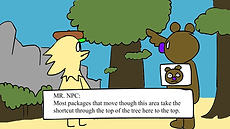
Since it is the sole landmark of the level, the large tree at the midway of the level should be clear from this area as a goal to traverse to. NPCs will even talk about it.
2. Once over, the new section gets back into vertical traversal by having collectables on trees and enemies to combat. The end point of this section asks them to use their package on a see saw to get high enough to pull it up to the next altitude. They will enter the big tree from here.
3. Once inside the big tree, this will serve as a break from the action, it will be hinted that many animals live here, and some will be interactable. This will also be where a lot of the mail gets delivered. The only way out of here is to traverse to the top of the tree by a lift.


4. Once atop the big tree, the vista of the forest and the size of this biome will be made clear. More importantly, this section will be the player's introduction to changing course on a zipline by leaning. There will be safe landing underneath as to not punish them.

5. After successfully changing course, the player will be led to another small sandbox zone where there will be enemies and a few letters to deliver. Secret areas will be found by those who explore more in depth and play more with the hook mechanic.

6. As we hit the climax of the level, we give the player a final test about changing course: a slightly longer zipline where there are both enemies and no safety to fall down to. The punishment is only a bit of damage, but it should be a little more challenging.


Each level will hide one special collector stamp for Peck's special collection. We will reward it those who spot it while riding in this area.
7. At the end of the level, we have a calm area where there are only a couple of houses. The hard part is over from here. If done correctly, the player will only have to deliver the package to one of the addresses here. They will also be rewarded with some lore regarding what the package was if they revisit this level after completing it.

They will then be able to use a convenient zipline that takes them back to the beginning of this level so that they can return to the hub world without backtracking.
Overall, Peck-age Delivery taught me a lot about what it takes for a game to be thought through completely and it truly doesn't come together without making solid levels to test your ideas. It also taught me that I love the top down process when it comes to games.